Blog / Flooring
Best Bathroom Flooring: What to Pick and Avoid
Tile and rigid-core vinyl suit a bathroom; hardwood and laminate do not. Subfloor prep, slip resistance, heated floors and Toronto install rates.
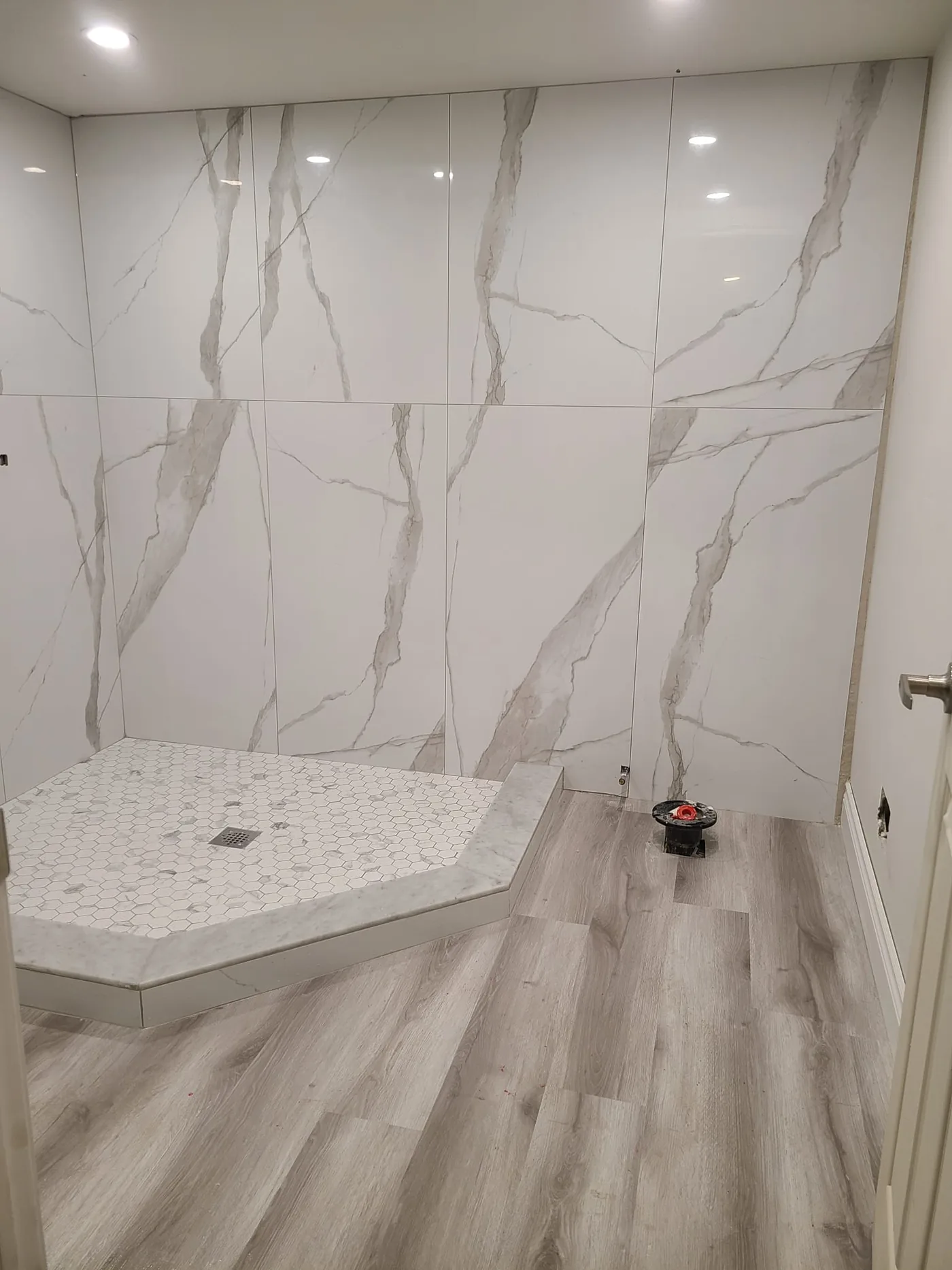
Quick answer
What works
A bathroom floor has to deal with standing water at the tub, steam from the shower, and a mop every week. That narrows the list quickly.
Why not hardwood
Older advice on this blog listed hardwood as a bathroom option. We are correcting that. Hardwood is a good floor in most of the house, and it is not the right floor here.
Solid hardwood is a single piece of wood, so it takes on moisture from the air and from spills, swells across its width, then shrinks again when the room dries. Over a season of showers that shows up as cupped boards, gaps and finish damage at the seams. Engineered hardwood is more stable because of its plywood or HDF core, but it is still a wood product with a wood veneer, and manufacturers generally do not warrant it for full bathrooms. Standard laminate has the same problem for the same reason: the fibreboard core swells at the joints and the damage is permanent.
If you want the look of wood in a bathroom, choose a vinyl plank with a wood grain print. You get the appearance without the risk. Keep solid hardwood and engineered hardwood for bedrooms, living areas and hallways.
Subfloor and moisture
Most bathroom floor failures start underneath, not on top. Whichever floor you pick, the preparation matters as much as the product.
One more point on wording. Tile itself absorbs very little water and rigid vinyl resists it well, but a bathroom floor is only as good as its grout, its seams and the subfloor under it. Treat the whole assembly as the waterproofing, not the surface alone, and check the rating the manufacturer gives the product you have chosen.
Check what is under there
Lift the old floor and look at the plywood or concrete. Soft spots, dark staining or movement near the toilet usually mean an old leak that has to be fixed before anything new goes down.
Flatten it
Tile cracks over a subfloor that flexes, and vinyl telegraphs every bump and old grout line. Levelling compound, an extra layer of plywood or filled grout lines are all normal preparation, and we quote them once we have seen the job.
Handle the water
A shower or a wet area needs the right membrane or underlayment beneath tile. In a basement bathroom on concrete, check for moisture before laying anything, because concrete can pass damp upward for years.
Seal the edges
Caulk where the floor meets the tub, the shower base and the toilet flange, and reset the toilet on a new wax ring. These joints are where water gets underneath a floor that is otherwise fine.
Slip resistance
A wet bathroom floor is the one place in a house where grip is a safety question, not a preference.
- Ask for the slip rating. Tile is sold with a slip resistance rating, often listed as a DCOF value. A floor tile meant for a wet area will have one; a polished tile meant for a wall may not.
- Avoid polished and high gloss tile on the floor. Matte, honed and textured finishes give far more grip when wet.
- Smaller tiles grip better. More grout lines means more texture, which is why mosaic is common on shower floors.
- Vinyl with texture helps. An embossed surface gives more grip than a smooth one.
- Add a mat. A bath mat at the tub and shower does more for safety than any product choice, particularly in a home with young children or older parents.
Heated floors
A bathroom is the room where in-floor heating earns its keep, because it is where you stand barefoot. Electric mats are the usual approach in a renovation: the mat is set in the mortar bed under tile and run off a thermostat on the wall.
Tile is the natural partner for heat. It carries and holds it well, and heating also takes the chill out of a floor that is cold by nature. Some vinyl can go over in-floor heating as well, but only products approved for it, and there is a maximum floor temperature to stay under. Check the manufacturer’s instructions before ordering, and tell us when we come out to quote if heating is planned, because it changes the build up of the floor and the finished height at the door.
Planning the reno
A few practical points that save money and delays in a bathroom project.
- Order the flooring before demolition. A bathroom is a small area, but a backordered tile can hold up a room you cannot use.
- Budget for the unknown. Old plumbing and hidden water damage turn up once the old floor is out. Set aside a contingency.
- Buy extra. Order more than the measured area to cover cuts and future repairs, and keep the offcuts. Product lines change, and an exact match later is not guaranteed.
- Mind the height. New underlayment, membrane or heating raises the floor. That affects the door swing and the transition to the hallway.
- Sequence the trades. Flooring usually follows plumbing rough in and goes down before the vanity and toilet are set.
Get it measured
Labour and material are priced separately. Tile labour depends on tile size, the layout and how much subfloor preparation the room needs, which is why we measure first rather than quote a flat rate. We cover Toronto and the GTA with a free in-home measure. Browse tiles or vinyl flooring, or see how we handle tile installation.
Frequently asked questions
What is the best flooring for a bathroom?
Porcelain or ceramic tile for a full bathroom with a shower or tub, and a rigid-core vinyl rated for wet areas as a warmer, cheaper alternative in a powder room or a second bathroom. Both work with a properly prepared subfloor.
Can you put hardwood in a bathroom?
We do not recommend it. Solid hardwood absorbs moisture and then cups, gaps and lifts, and engineered hardwood is generally not warranted for full bathrooms either. If you want a wood look, use a vinyl plank with a wood grain print.
Is laminate flooring alright in a bathroom?
Standard laminate is not. Its core is fibreboard, so once water gets past the joints the edges swell and the damage is permanent. Vinyl is the better choice at a similar installed cost.
Which bathroom floor is least slippery when wet?
A matte, honed or textured tile with a published slip resistance rating, or a textured vinyl. Avoid polished and high gloss tile on a bathroom floor, and use a mat at the tub and shower.
How much does a bathroom floor cost to install in Toronto?
Click vinyl installation starts at $3.20 per square foot and glue-down vinyl at $5.50 per square foot including glue. We confirm the total after a free in-home measure, because the tile, the pattern and the subfloor all change the job. The flooring material and any levelling are priced separately; taking up the old floor is included.
Keep reading