Blog / Flooring
Recapping vs Refinishing Stairs
Refinishing a staircase runs $6,000 to $7,000 a flight and recapping with new treads and risers about $7,000. Which one you need depends on what is under the carpet, not on price.
Quick answer
Most pages you’ll read on this put refinishing in the “cheap option” column and recapping in the “expensive” one. On our jobs that gap doesn’t exist. A flight refinished properly and a flight recapped with new hardwood land within a few hundred dollars of each other, and we quote both the same way: by the flight, in writing, before anyone starts.
So the real question is the one nobody asks first. What are your stairs actually made of?
What each job means
Refinishing keeps your existing treads and risers. We sand them back to bare wood, fill what needs filling, repair squeaks and loose boards, then stain and finish. The staircase that comes back is the same staircase, in a new colour and sheen. More on that work is on our hardwood refinishing page.
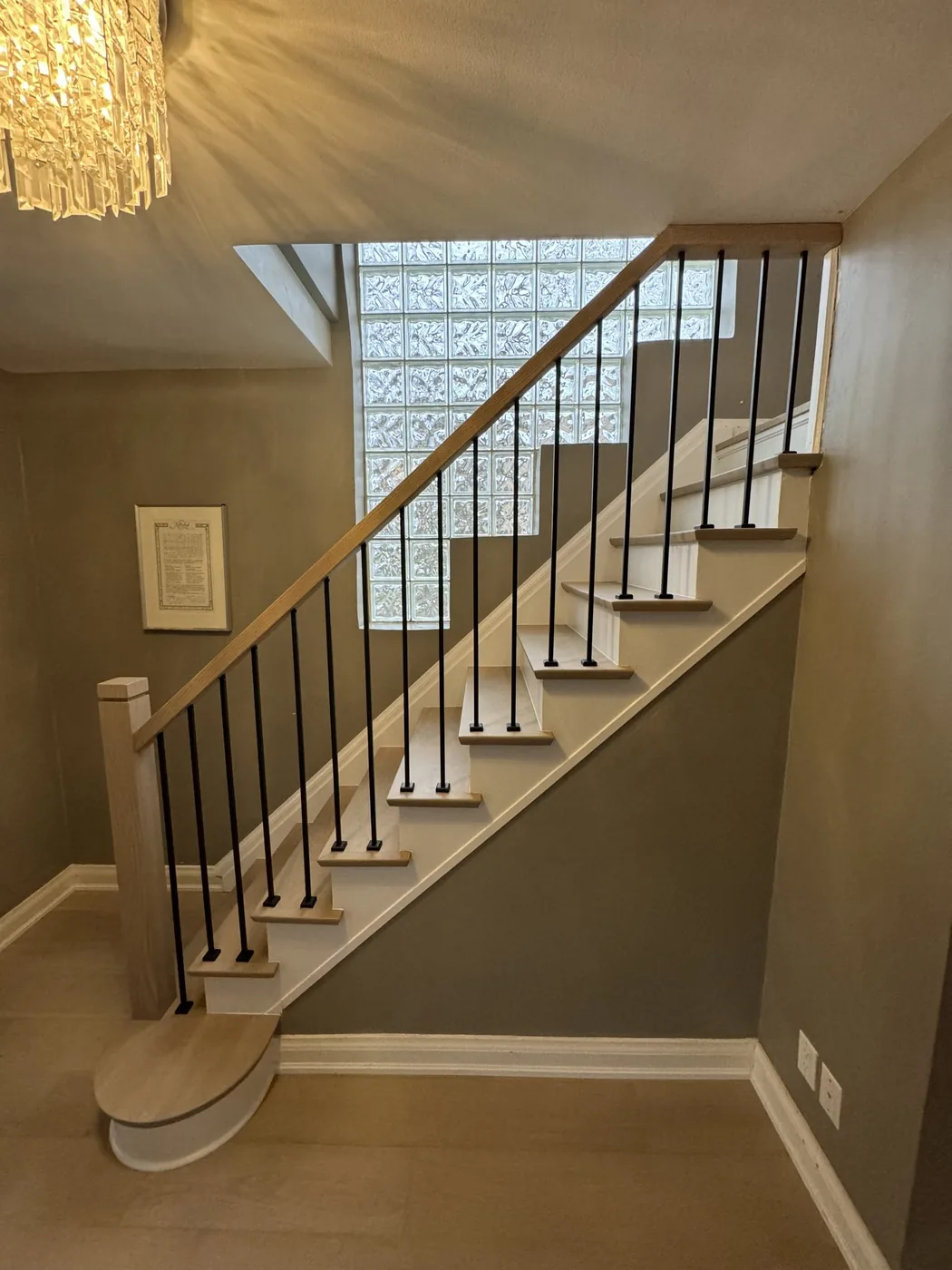
Recapping covers the existing structure with new hardwood treads and risers. The old carpet comes off, the stringers stay, and the staircase becomes solid wood without tearing anything out. Posts, spindles and the handrail are usually replaced at the same time, because that’s when they’re easiest to get at. That’s the job described on our staircase renovation page, and if you’re coming off carpet, carpet to hardwood stairs walks through it step by step.
What each costs
The recapping price covers taking the carpet off, new treads and risers, newel posts, spindles, the handrail, and staining to match your floor. Refinishing covers the sanding, repairs, stain and finish coats. Both are priced per flight, not per step, and both are fixed in writing after a free in-home measure.
Townhouses are the exception worth naming. A townhouse flight often has more steps than a bungalow’s, plus more spindles and more linear feet of handrail, so the number climbs even though it’s still “one flight”.
Refinish when the staircase is worth keeping
Refinishing wins when the bones are good. Solid oak treads with twenty years of wear, a dated orange-ish stain, a scratched finish from a dog that has since retired: that staircase does not need replacing. Sand it, stain it, finish it, and it looks new.
Two things decide whether it’s possible:
- Are the treads solid hardwood? Solid treads can be sanded several times over their life. Engineered treads have a thin wear layer and can usually take one sanding, sometimes none.
- Is there enough thickness left? If the stairs have already been sanded twice, or the nosings are worn thin at the front edge, there may be nothing left to take off. We check that at the measure, not after the machines are out.
Something to plan around: refinishing is dusty and it smells. The flight is out of use while the coats dry, which is fine in a house with a second staircase and awkward in a house without one.
Recap when the stairs were never meant to be seen
Lift the carpet on a lot of GTA houses and there’s no hardwood under it at all. Builder-grade stairs are often pine, spruce, or a plywood-and-particle-board sandwich with a rough nosing, built on the assumption that carpet would cover them forever. You can’t sand that into a finished staircase. There is nothing to finish.
That’s what recapping is for. New treads and risers cap what’s there, and the result is a solid wood staircase without ripping out the structure. It’s also the answer when the treads are cupped, split or squeaking badly, when previous owners painted them, or when you want the stairs to match a new floor exactly, including herringbone and wide plank.
One more case for recapping: you’re replacing the floor anyway. Matching new treads to a new floor in species, stain and sheen is straightforward while both are on site. Matching a refinished 1990s staircase to a new engineered floor is a colour-matching exercise that sometimes ends in a compromise.
How long each one takes
A recap is three to four days for a flight, and a flight with a landing is the same three to four days. You can use the stairs overnight and while the crew is in the house.
Refinishing runs on the drying, not the labour. Sanding and staining happen fast; the finish coats decide the schedule, and the flight stays off limits between coats.
For most families that’s the tiebreaker, not the price. A staircase is the one part of a renovation you can’t route around.
How to tell which one you need, before we arrive
- Pull the carpet back at the top step, in the corner. It’s tacked, not glued, and it lifts with pliers.
- Look at the tread edge. Solid hardwood shows the same grain through the thickness. Plywood shows layers. Particle board looks like compressed chips.
- Look at the nosing, the rounded front edge. Builder-grade stairs often have a thin nosing strip nailed on, with plain lumber behind it.
- Send us a photo of that corner with your square footage. That one picture usually settles recap or refinish before anyone visits.
What we’d tell you to do
Solid hardwood treads with life left: refinish. Carpeted, builder-grade, painted or damaged: recap. Replacing the floor at the same time: recap, so the wood matches. Unsure: send the photo.
We supply carpet but don’t install it, so if the plan is new carpet on the stairs, we’re the wrong crew for that part, and we’ll say so.
We work across Toronto and the GTA, and longer trips have taken our installers as far as Bowmanville, Castleton, Wasaga Beach, Niagara Falls and London.
Get a price for your staircase
Send the number of flights, whether there’s a landing, and a photo of the top step with the carpet pulled back. You’ll get a fixed written price for both options where both are possible.
Frequently asked questions
Is refinishing stairs cheaper than replacing them?
Not by much. Refinishing a flight runs about $6,000 to $7,000 and recapping with new treads and risers is about $7,000. Choose on what the existing staircase is made of, not on price.
Can carpeted stairs be refinished?
Only if there is solid hardwood under the carpet, which is less common than people expect. Builder-grade stairs are often pine or particle board with a thin nosing, and those get recapped in hardwood instead.
How many times can a staircase be refinished?
Solid hardwood treads can usually take several sandings over their life. Engineered treads have a thin wear layer and often allow one, sometimes none. We measure what is left before recommending it.
How long does refinishing a staircase take?
The sanding and staining are quick; the finish coats set the schedule, and the flight cannot be used between coats. A recap is three to four days a flight and the stairs stay usable overnight.
Do you replace spindles and handrails as well?
Yes. Newel posts, wood, wrought iron or glass spindles, and new handrails including wall-mounted and continuous rails around landings. Spindle-only or handrail-only jobs are quoted separately.
What does a curved staircase cost?
About $10,000 a flight. Townhouse staircases usually come in higher than a standard flight because they have more steps, spindles, posts and handrail.
Keep reading