Blog / Flooring
How Engineered Hardwood Is Installed
How engineered hardwood is built and installed: nail, glue or float, subfloor prep, acclimation, what your crew brings, and Toronto install rates.
Quick answer
What it is
An engineered board is built in layers. The top layer is a veneer of real hardwood, the same species and finish you see on a solid board. Under it sit several plies of wood or a dense fibreboard core, each layer laid across the one below so the board pulls in different directions instead of all at once. That cross layering is why engineered wood copes better with the humidity swing in a Toronto house, damp in July and dry in February.
The number that matters most is the veneer, sometimes called the wear layer. A thin veneer of around 0.6 mm is a surface you clean and protect but never sand. A veneer of 2 mm or more can usually take one light sanding. At 3 mm to 6 mm you are into boards that can be refinished more than once. Ask for the veneer thickness in millimetres before you compare two boards on price, because two floors at the same price can be very different products.
The core matters too. A plywood core holds a nail or staple well. A dense fibreboard core often does not, which is why some wide click boards are float only.
Three ways to install
The board, the subfloor and the room decide the method, not your preference. A good installer will tell you which of the three your floor allows.
Nail and staple are the same idea with a different fastener. A cleat nail allows a little movement, a staple grips harder. Both go through the tongue of the board at an angle so nothing shows on the surface. Neither works over concrete, because you cannot fasten into a slab.
Glue down is the method for concrete and for condo units, and it is what most wide plank floors need. The adhesive is spread with a notched trowel and the boards are set into it, so the floor is bonded across its whole surface. It needs a flatter subfloor than the other two.
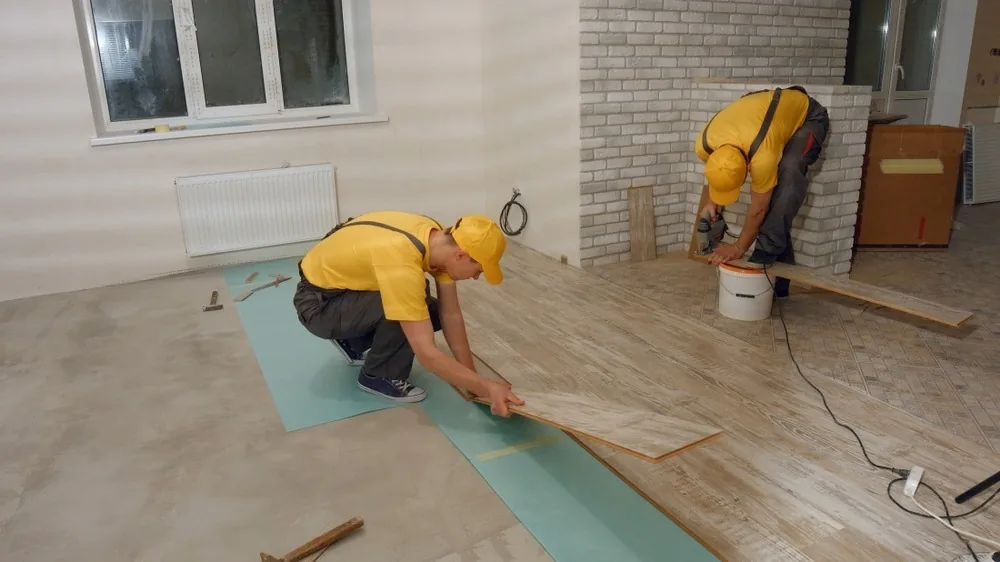
A floating floor touches nothing. The boards lock to each other, sit on a foam or rubber underlay, and are held in place by their own weight with an expansion gap at every wall. It is quick and reversible. It also sounds more hollow than a glued floor, which a better underlay reduces but does not remove.
Subfloor and acclimation
More engineered floors fail from what is under them than from the wood itself. Two things get checked before anything is opened.
Flatness. The subfloor has to be flat within the tolerance your manufacturer lists, commonly around 3 mm over 3 metres. Dips get filled with levelling compound, high spots get sanded. A floor laid over a dip flexes there, and with a click floor the joints eventually separate.
Moisture. Concrete holds water long after it looks dry, and a basement slab in an older house may have no vapour barrier at all. A moisture reading on the slab and on any wood subfloor is standard practice, and it decides whether a barrier or a moisture rated adhesive is needed. Skipping that reading is the most common reason a wood floor cups later.
Acclimation is the wood sitting in the room it will live in, boxes open or cross stacked, until its moisture content matches the house. Follow the instruction for your product, usually two to five days. The house needs to be at normal living temperature and humidity while that happens.
Who brings what
Buy about 10 percent more material than the room measures. That covers cuts, the odd damaged board and a couple of spares for a future repair. On a diagonal or herringbone layout, allow more.
We bring the tools
Flooring nailer or stapler and compressor, notched trowels and adhesive, mitre and table saws, jigsaw, oscillating multi-tool, moisture meter, straight edge, levelling compound, underlay, transitions and trim.
You clear the room
Furniture out, closets emptied, wall hangings down, electronics and anything fragile moved to another room. An empty room is faster and cheaper to work in than a room we have to shuffle around.
You sort the services
Power and heat on, parking or an elevator booking for a condo, and a decision on whether baseboards come off and go back on or stay and get quarter round.
We sort the site
Old floor removal and disposal, subfloor repair and levelling, dust collection while cutting, and a sweep at the end of each day.
Engineered against solid
What it costs
The flooring itself is priced separately, so your total is material plus installation. Removal of the old floor, subfloor levelling, stairs and trim work are quoted after we measure. The quote is free across Toronto and the GTA, and it is when the moisture and flatness checks get done.
Browse engineered hardwood or solid hardwood, and see how we handle hardwood installation. If you are budgeting a whole floor, read how much a flooring renovation costs.
For the full comparison, including Toronto humidity, condos on concrete and refinishing, read engineered vs solid hardwood.
Frequently asked questions
How much does engineered hardwood installation cost in Toronto?
At 22FLOORING, engineered hardwood installation starts at $4.90 per square foot including glue and nails. If the product only clicks and floats, installation starts at $3.20 per square foot. The flooring material is priced separately, and removal, subfloor preparation and stairs are priced in your free quote.
Can engineered hardwood be glued to concrete?
Yes. Glue down over a slab is the usual method in basements and condos, provided the slab is flat, dry on a moisture test, and the adhesive is rated for the reading you get. A floating click floor over underlay is the other option.
How long does engineered hardwood need to acclimate?
Follow the instruction for your product, which is commonly two to five days in the room where it will be installed, with the house at normal living temperature and humidity.
Can engineered hardwood be refinished?
It depends on the veneer thickness. Around 2 mm usually allows one light sanding, and 4 mm or more allows several. A thin veneer of roughly 0.6 mm should not be sanded, so ask for the thickness in millimetres before you buy.
Is engineered hardwood better than solid hardwood?
Neither is better everywhere. Engineered moves less with humidity and can go over concrete and below grade, so it suits basements, condos and wide plank layouts. Solid hardwood can be sanded more times over its life and suits a plywood subfloor above grade.
Keep reading