Blog / Flooring
Carpet to Hardwood Stairs
Carpet stairs to hardwood in Toronto: what's under the carpet, how the stairs are capped, and why a full flight usually costs about $7,000. Free visit.
Quick answer
That’s the short version. If you’re weighing it up, the rest of this explains what’s actually under your carpet, what happens on the day, what moves the price, and why it’s worth doing the stairs and the floor at the same time. For the full breakdown of staircase work and pricing, see what a full staircase renovation costs.
What’s under the carpet on your stairs?
On most stairs that were built to be carpeted, the treads underneath are construction-grade wood that was never meant to be seen. It’s structure, not finish. That’s why carpeted stairs are usually capped with new hardwood treads and risers rather than sanded back. There’s nothing underneath worth refinishing.
Not always, though. Some older homes have real hardwood treads under carpet somebody laid in the eighties. If you want to know before anyone comes out, lift a corner of the carpet at the top step against the wall, where it won’t show, and look at the edge of the tread.
- Plain, knotty or patched boards, or sheet material: that’s structure. It gets capped.
- A finished hardwood edge: you might be looking at a refinish instead of a remodel. We do both, and refinishing existing stairs is quoted on its own.
Send us a photo of what you find. It changes the quote.
How carpet stairs become hardwood
This is the order the job runs in:
- The carpet comes off. Carpet, underpad, tack strips and every staple. Stairs hold a surprising amount of metal.
- Every step gets checked. Loose or squeaking treads are fixed now, while they’re open. Capping a step that moves just hides a squeak under nicer wood.
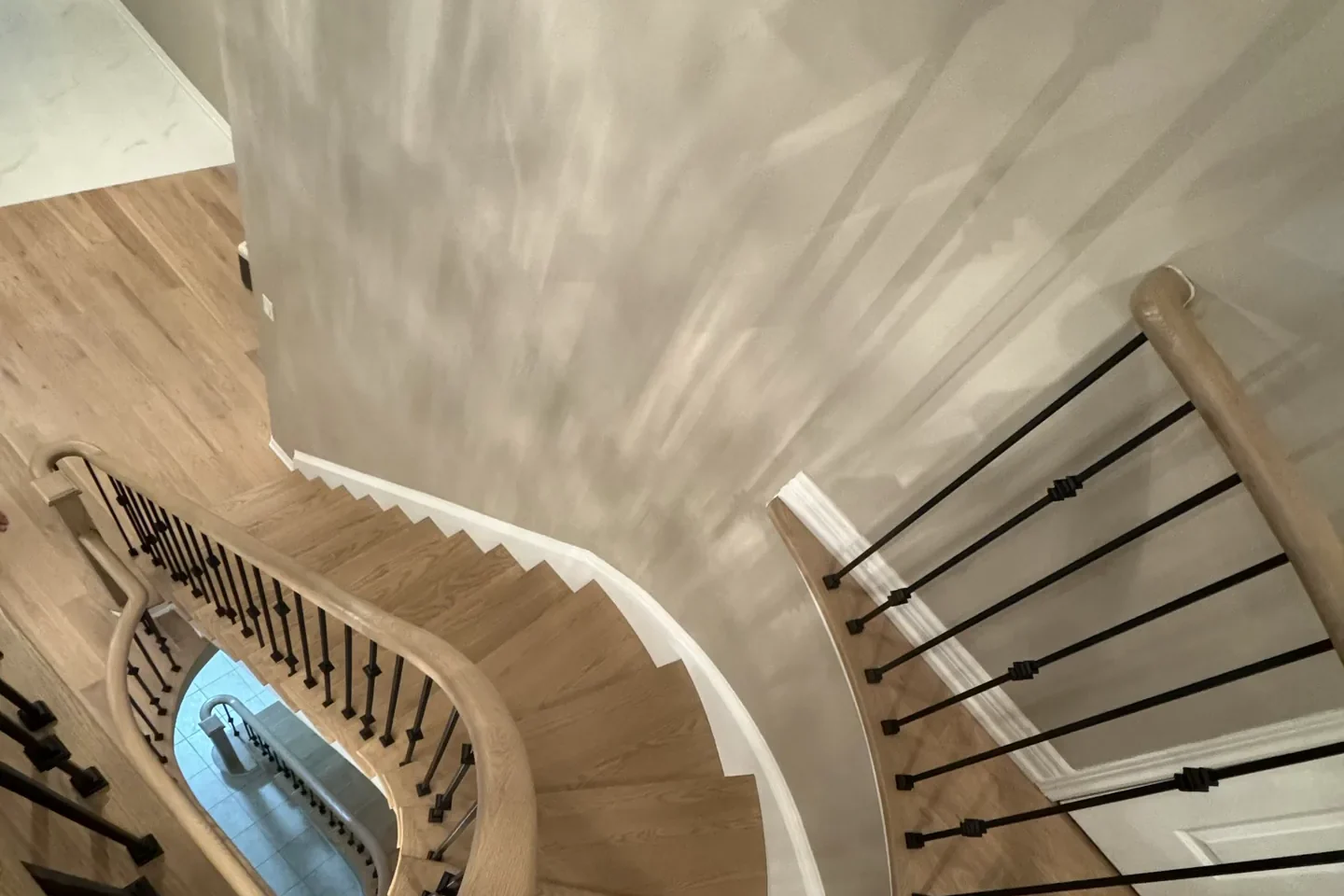
- New treads and risers go on over the existing structure. This is the capping. The staircase keeps its frame; what you see and walk on becomes solid hardwood.
- Nosings finish the edge of each tread, so the step reads as one piece of wood rather than a board sitting on a box.
- Stain is matched to your floor, in species, colour and sheen, so the stairs and the rooms around them finish as one look.
- The railing: new newel posts, spindles and handrail, all part of the flight price.
Remodelling like this is different from replacing a staircase. Replacing means removing the staircase itself. It’s a much larger job, and it’s rarely needed when the stairs are solid underneath.
What does converting carpet stairs to hardwood cost?
What moves the price up or down within that:
- The number of steps. A short run costs less than a tall one.
- Landings. Each one is extra floor to cap and extra rail to run.
- The shape. Straight stairs are the simplest. L-shaped stairs take more cutting and fitting, and curved ones the most.
- The finish you choose, including the stain and the railing style.
Smaller jobs are priced on their own: swapping spindles while keeping the steps, replacing a handrail, or refinishing treads that are sound but tired.
You’ll see other companies quote per step. We quote the flight, in writing, for the work described. There’s no hourly billing and nothing added on the day, so the number in the quote is the number you pay.
Do the stairs and the floor at the same time
Here’s the part most people don’t plan for. Carpeted stairs almost never end at the top step. There’s a carpeted hallway, a landing, sometimes a bedroom beyond it. Replace the stairs alone and you’ve got new oak stopping dead against old carpet.
If your staircase is carpeted and you’re putting down a new floor anyway, we recap the stairs in the same wood while we’re there. One supplier for the floor and the treads means the species, stain and sheen actually match, because they come from the same place and go down with the same crew. That includes herringbone and wide-plank floors, where a mismatched stair is obvious from the front door.
We carry over 5,000 floors, so the stairs can follow the floor rather than the other way round. About nineteen of every twenty hardwood floors we lay are engineered, because it handles the humidity swings of a Toronto house. You can browse the engineered hardwood range before the visit.
Railings: what changes
The flight price includes a new railing: posts, spindles and handrail. That matters, because once the carpet’s gone a dated railing usually becomes the first thing you notice. If you love the one you have, say so at the visit.
- Newel posts, the thick posts at the bottom, top and turns. Square, tapered or box-style. Changing them alters the character of a staircase more than any other single part.
- Spindles (balusters), the uprights between rail and step. New wood, wrought iron, or glass panels. These can also be swapped on their own without touching the treads.
- Handrails, including wall-mounted rails and continuous rails that carry around a landing, finished to match the treads or stained as a contrast.
Doing the railing while the stairs are open means one crew, one visit and one stain match.
How long does it take?
About three to four days for one flight. A landing doesn’t add time: a flight with a landing takes the same three to four days.
And you’re not locked out of your own upstairs. The stairs stay usable overnight and whenever you’re home, so nobody’s sleeping on the couch while the treads go on.
Staircases we’ve converted
Real jobs, photographed by our crew:
- Flooring and staircase renovation in Castleton
- Staircase and flooring renovation in Bolton
- Flooring and stairs renovation in Richmond Hill
- Staircase renovation in East York
More on our work page.
Get a price for your stairs
Send us a few photos of the staircase and tell us how many flights. We’ll tell you what the job involves before anyone comes out, then book a free visit to measure and confirm a fixed price.
Frequently asked questions
How much does it cost to convert carpet stairs to hardwood in Toronto?
About $7,000 for a full flight with us, covering carpet removal, new hardwood treads and risers, posts, spindles, handrail and the stain to match your floor. Curved staircases run closer to $10,000, and townhouses usually come in higher. Every quote is a fixed written price.
How long does converting carpet stairs to hardwood take?
About three to four days for one flight, and the same for a flight with a landing. You can still use the stairs overnight and whenever you’re home during the job.
Can you match my stairs to my hardwood floors?
Yes. New treads are matched to your new or existing floor in species, stain and sheen, including herringbone and wide plank, so the stairs and the rooms around them finish as one look.
Can the stairs under my carpet be refinished instead?
Sometimes. If there’s finished hardwood under the carpet, refinishing may be enough, and it’s quoted separately. Most stairs built for carpet have construction-grade treads underneath, which are capped with new hardwood instead.
Do you have to replace the whole staircase?
No. The new treads and risers go over the existing structure. Replacing the staircase itself is a much bigger job and rarely needed when the stairs are solid.
Do you install carpet runners?
No. We supply carpet but don’t install it, so we don’t fit runners on stairs.
Keep reading