Blog / Flooring
Engineered vs Solid Hardwood: Which to Choose in Toronto (2026)
Engineered or solid hardwood for a Toronto home? Compare construction, winter humidity, condos on concrete, refinishing and real installed prices: engineered $4.90, solid $4.50 per sq ft.
Quick answer
The two floors side by side
What the difference actually is
Solid hardwood is a plank milled from a single piece of oak, maple, hickory or walnut, normally 3/4 inch thick, with a tongue and groove on the edges. It is the floor most older Toronto houses were built with, and it can be sanded and refinished many times over its life.
Engineered hardwood puts a layer of that same real wood, the veneer, on top of a core built from plies of wood running in alternating directions. The face is genuine hardwood, so it looks, feels and refinishes like solid. The core is what changes: it stays flatter and more stable than a single plank of wood ever can.
Toronto winters and summers
This is the argument that settles it for most people. Wood takes on moisture in a humid Toronto summer and gives it back in a furnace-dry winter, swelling and shrinking as it goes. In a solid floor that shows as gaps between boards in January and cupping in August. An engineered core moves a fraction as much, because the plies pull against each other. It is the reason engineered is the floor we install nineteen times out of twenty.
Condos, basements and concrete
Solid hardwood has to be nailed to a wood subfloor, which rules out concrete. Most Toronto condos sit on a slab, and so do basements, so engineered is the only hardwood that can go there: glued down or floated, often over an acoustic underlay to meet the building’s sound rules. If you live in a tower or want wood in a finished basement, the choice has been made for you.
Refinishing and lifespan
A solid floor can be sanded back five or six times over eighty years or more. Engineered can be refinished too, but the number of times depends on the veneer: a 2 mm face allows one light sand, a 4 mm or 6 mm face allows several. When you compare products, the veneer thickness is the number to look at, not the total thickness of the plank. Many of the engineered floors we stock, from Origins, Lucid, GreenTouch, Fuzion and Richmond, carry a 3 to 4 mm face.
Radiant heat, wide planks and herringbone
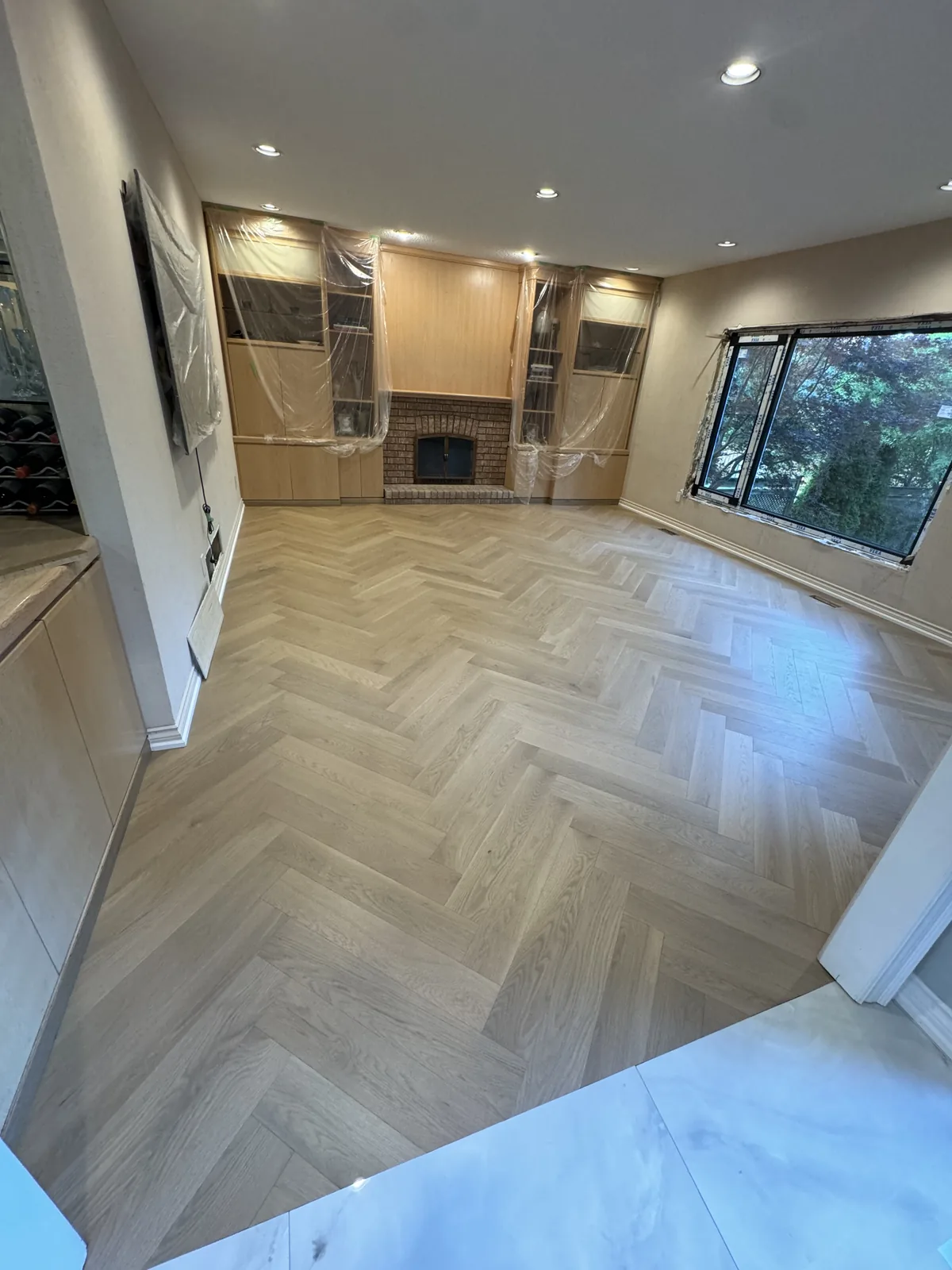
In-floor heating dries wood from below, which is hard on solid boards and is why many solid warranties exclude it. Engineered tolerates it far better. The same stability is what makes wide planks, herringbone and chevron practical: a 7 inch solid plank will cup, a 7 inch engineered plank stays flat, and herringbone in particular is nearly always laid in engineered.
What each costs installed in Toronto
22FLOORING installs engineered hardwood from $4.90 per square foot, including glue and nails. Engineered floors that only click together and float are from $3.20 per square foot. Solid hardwood is from $4.50 per square foot. The flooring is priced separately, and every hardwood product page on our site shows both figures.
Solid costs slightly less to install because it only ever nails down; engineered costs more because it is usually glued as well as nailed. Subfloor levelling, removing an old floor and stairs are quoted after a free measure. A carpeted staircase can be recapped in the same wood while the crew is there, at about $7,000 a flight.
Which to choose, room by room
- Condo or basement on concrete: engineered, glued or floated.
- Main floor of a detached house over plywood: either. Engineered for wide plank or herringbone; solid if you want a floor to refinish for decades.
- Upper floors and bedrooms: either. Engineered if the house has forced-air heat and dry winters, which in Toronto is most of them.
- Kitchens: engineered, for its stability near sinks and dishwashers. Neither is waterproof.
- Over radiant heat: engineered.
Shop both
Browse about 1,500 engineered hardwood floors and our solid hardwood range, or read how we fit them: engineered hardwood installation in Toronto. Send us your square footage for a free in-home measure across Toronto and the GTA.
Frequently asked questions
Is engineered hardwood real wood?
Yes. The surface you walk on is a veneer of real oak, maple, hickory or walnut. Only the core underneath is made of wood plies instead of a single plank.
Can engineered hardwood be refinished?
Yes, as long as the veneer is thick enough. A 3 to 4 mm face can be sanded and refinished more than once; a 2 mm face allows one light sand.
Which is cheaper to install?
Solid, slightly: from $4.50 per square foot against $4.90 for engineered including glue and nails. Engineered floors that only click and float are from $3.20.
Can I put solid hardwood in a condo?
Not over a concrete slab, because solid has to be nailed to a wood subfloor. Engineered is glued or floated over concrete and is the hardwood used in Toronto condos.
Which lasts longer?
A solid floor can be refinished more times, so it can outlast the house. A quality engineered floor with a thick veneer lasts decades and stays flatter through Toronto’s seasons, which is why we recommend it for most homes.
Keep reading