Blog / Flooring
IIC and STC Ratings Explained for Toronto Condo Floors
What IIC and STC ratings measure, why Toronto condo boards ask for them, and why the number on the box can differ from a test in your suite.
Quick answer
IIC (Impact Insulation Class) rates how well a floor and ceiling stop footsteps reaching the suite below. STC (Sound Transmission Class) rates airborne sound like voices and TV. Higher is quieter for both. Condo boards ask because Ontario’s Building Code sets airborne minimums between suites but no footstep minimum, so that number comes from your building’s rules.
What IIC and STC actually measure
Both rate a whole floor-ceiling assembly, from the flooring down to the ceiling below. Neither rates a plank on its own.
IIC is about impact. In the lab test (ASTM E492), a standard tapping machine with five steel-faced hammers pounds on the floor while microphones in the room below record the noise, and ASTM E989 turns the readings into one number. The National Research Council of Canada (NRC) notes the machine doesn’t sound much like someone walking, so a floor with a decent IIC can still pass low thumps.
STC covers airborne sound like talking or the TV next door. The lab test is ASTM E90, rated under ASTM E413. With both, a bigger number means less sound gets through.
Why your condo board asks for them
Ontario’s 2024 Building Code says a suite must be separated from neighbouring spaces by construction reaching an apparent sound transmission class (ASTC) of at least 47, or by an assembly rated STC 50 or better with the surrounding construction built to the code’s details. Next to an elevator shaft or garbage chute, it’s STC 55.
Those are all airborne rules. There’s no footstep requirement between suites. The code’s explanatory notes say footsteps can cause severe annoyance and recommend IIC 55 for bare floors, but only as guidance. A 2024 Condominium Authority Tribunal decision put it plainly: the code sets no IIC standard.
So impact noise is left to each building. The Condominium Authority of Ontario says noise provisions are most likely in a condo’s declaration or rules, which is where your flooring rule will be. Ask the property manager for it in writing before you pick a floor.
Hard floors on bare concrete are why boards care. In NRC tests on a 150 mm slab, hardwood laid straight on the concrete scored roughly IIC 30 to 35, barely better than the bare slab at 28.
Lab ratings and field ratings are different numbers
The IIC and STC on a product sheet come from a lab, measured on whatever slab and ceiling that lab built. Your building has its own.
Field tests happen in the finished suite. ASTM E1007 measures impact sound on site and gives AIIC (apparent impact insulation class), the rating that used to be called FIIC. ASTM E336 is the airborne version and gives ASTC; some condo rules say FSTC, which is also a field rating. Field numbers include flanking, sound that travels around the floor through walls and other structure. The Building Code’s notes say an ASTC will always come out equal to or lower than the STC for the same construction.
A 2022 tribunal case shows how far apart they can land. The underlay packaging listed IIC 73 and STC 72. An acoustic consultant then measured the finished floor-ceiling between the two suites at FIIC 57. Another consultant in the same case called the ratings on underlay packaging misleading, since they reflect lab testing of the product.
So read your rule’s wording. If it asks for IIC and STC, the board wants lab sheets. If it says FIIC, AIIC, FSTC or ASTC, it wants a test in your suite after the floor is down, so ask who books that test and when.
What the underlay does
A hard floor on concrete passes each heel strike straight into the slab. Underlay adds a soft, springy layer in between that cushions the hit first.
The NRC found wood flooring over a resilient layer can give acceptable impact control, and that the result depends mostly on the resilient material, such as rubber or cork. Thicker usually helps, though not always. On the same 150 mm slab, 9 mm hardwood over a 6 mm resilient layer came in around IIC 45 to 50.
Two things matter on site. The Woden vinyl planks listed below come with a pad attached, and the sheet’s rating covers plank and pad together, so don’t add a second underlay unless the maker’s install guide allows it. And sound finds shortcuts: NRC guidance on floating floors says the baseboard shouldn’t touch the floor surface, because that contact lets sound bypass the resilient layer. Considering glue-down vinyl? Check your building’s rule first, then see our click vs glue-down vinyl comparison.
What to hand the board
Put these in one package:
- Your building’s number, and whether it’s a lab or field rating.
- The sound-rating sheet for the underlay, or for the plank with its attached pad. For condos we use underlay that meets the building’s rating and give the board that sheet for approval.
- The product name, its thickness and how it goes down: floating click or glue-down.
- The contractor’s certificate of insurance and WSIB clearance. We supply both on request; we’re licensed and insured up to $2 million.
- Your work dates. We work inside the property manager’s window and book the service elevator.
Order only once approval is in writing. Our guide to condo flooring in Toronto covers the rest.
Condo floors we carry with published sound ratings
These list IIC and STC on the maker’s sheet. Your board decides whether they meet its rule.
- Woden 701 Sandy Shell: IIC 72 and STC 71 with its 1.5 mm attached pad.
- Woden 904 Vanilla Coconut: IIC 73 and STC 72, with a 2 mm pad and a 22 mil wear layer.
- Woden 1104 Vintage Cream: IIC 73 and STC 72 in a 9 inch wide plank with a 2 mm pad.
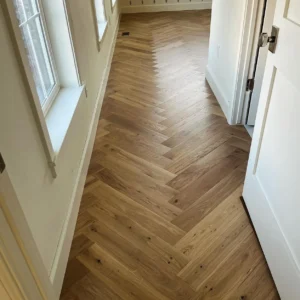
- Woden H04 Light Champagne: herringbone vinyl rated IIC 72 and STC 71, with a 1.5 mm pad. Our herringbone installation page explains the layout.
- Vidar American Oak Click 5 Sky: real white oak with click edges, 13 mm thick. Its sheet lists no sound rating, so it goes over an acoustic underlay picked for your building’s rule.
There’s more in our vinyl flooring range. Installation per square foot, for installation only (disposal, trim, levelling and other prep are quoted separately): laminate, click vinyl and click engineered $3.20; engineered glued or nailed $4.90; glue-down vinyl $5.50, glue included. Solid hardwood isn’t for concrete condo slabs. Flooring is quoted separately; our Toronto installation cost guide has the breakdown. The in-home measure and quote are free, and we bring samples.
Frequently asked questions
What IIC rating does a Toronto condo need?
There’s no city-wide number. Ontario’s Building Code has no footstep requirement between suites; its notes only recommend IIC 55 for bare floors. The number that counts is in your building’s declaration or rules, so ask the property manager.
Is a higher IIC or STC better?
Yes, a higher number means less sound gets through. Just don’t compare a lab IIC with a field AIIC; they’re different measurements.
What’s the difference between IIC and FIIC?
IIC is measured in a lab under ASTM E492. FIIC, now usually written AIIC, is measured in your building under ASTM E1007, so it includes sound travelling through walls and connected structure.
Does a better underlay raise the STC?
Don’t count on it. Underlay is there for footsteps, and NRC research notes a floor can score high on IIC and still have a low STC.
Can I install solid hardwood in a condo?
Not on a concrete condo slab; we don’t install solid hardwood on one. Engineered hardwood or vinyl over the right underlay is the usual route, and our engineered vs solid hardwood comparison explains why.
Keep reading