Blog / Flooring
What Is a Wear Layer on Vinyl and Engineered Floors?
How vinyl wear layers in mil and engineered hardwood wear layers in mm compare, what they protect, and how thick wood must be to refinish.
Quick answer
A wear layer is the top layer that takes the traffic. On vinyl it’s a clear coat over the printed pattern, measured in mil: 12 mil is about 0.3 mm and 20 mil about 0.5 mm. On engineered hardwood it’s real wood, measured in millimetres, and its thickness decides whether the floor can be sanded and refinished.
One name, two different layers
The term covers two quite different things.
The National Wood Flooring Association defines an engineered floor’s wear layer as its outermost layer, the side you see once it’s installed. On vinyl, flooring makers describe it as the clear coating on top of the printed design.
Mil is not millimetres
A mil is one thousandth of an inch. An inch is exactly 25.4 mm, so one mil works out to 0.0254 mm. A 20 mil wear layer is about half a millimetre thick.
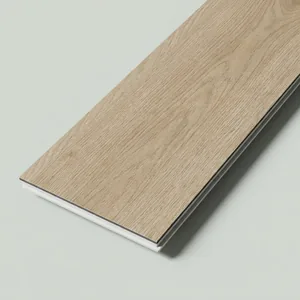
Don’t confuse the wear layer with the plank’s thickness. Woden’s 102 Woodcraft is a 5 mm SPC core with a 2 mm pad and a 12 mil wear layer. Woden’s 701 Sandy Shell is a 5.5 mm core with a 1.5 mm pad and a 20 mil wear layer. Similar builds, very different tops. Find the line on the spec sheet that says wear layer.
Choosing 12, 20 or 22 mil vinyl
A thicker wear layer gives more clear material between your shoes and the print. MSI, a flooring supplier, rates 12 mil for active homes, rentals and moderate traffic, and calls 20 mil the commercial standard for offices and retail.
- 12 mil. Bedrooms, guest rooms, a condo with no pets, a rental. Keep a mat at the door and felt pads under the chairs.
- 20 mil. Main floors, kitchens, hallways and homes with a dog.
- 22 mil. For the entry and kitchen of a house with kids and big dogs. See our flooring for dogs and pets guide.
The wear layer and the core are separate choices. Twelve Oaks North Star has a 20 mil wear layer on a WPC core, which feels softer underfoot. Sandy Shell has the same 20 mil on a rigid SPC core. In a condo, our condo flooring guide covers the underlay side.
What a vinyl wear layer won’t do
- Stop dents. Heavy furniture presses into the plank. Care guides for rigid core vinyl say to put protective pads under furniture legs and mats under rolling chairs.
- Stop gouges. Dragging an appliance can cut into the plank. Deep gouges and chips mean swapping the plank.
- Make it waterproof. That comes from the core. On our Woden SPC planks, the spec text credits the stone-composite core for keeping them waterproof.
- Get sanded. Vinyl can’t be refinished. Sanding damages the wear layer, and once it’s worn through, the printed layer shows and the plank can need replacing.
Grit is what wears the clear layer down. The care guides stress two habits: mats on both sides of exterior doors and regular sweeping. For how vinyl compares with laminate overall, read laminate vs vinyl plank.
Engineered hardwood: the real wood on top
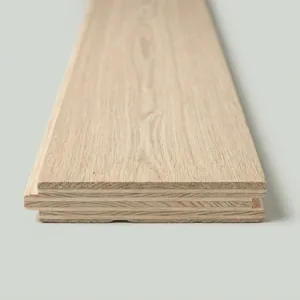
On engineered hardwood, the wear layer is a slice of real wood over a multi-layer core. On the engineered floors in this guide it’s 2, 3 or 4 mm. The factory finish sits on top of that wood; Vidar’s Snow White, for example, has a BONA UV lacquer. Light scuffs live in the finish, and the wood underneath is what you sand when the finish is past saving.
The NWFA’s guidance gives you the numbers to judge it. Sanding isn’t recommended when the wear layer is under 3/32 of an inch, about 2.38 mm. Its refinishable certification asks for at least 2.5 mm on factory-finished floors. A normal sanding takes off up to about 1/32 of an inch (roughly 0.8 mm), and a heavier one up to 1/16 (about 1.6 mm).
So if you want the option to refinish more than once, 4 mm is the safer pick. Some floors give you the choice: Vidar’s 9″ American White Oak Wheatberry comes with a 3 mm or 4 mm oak face. A tired finish doesn’t always need a full sand, either. The NWFA notes that a maintenance recoat may be enough.
See also engineered vs solid hardwood and refinish or replace hardwood floors.
Floors in our range, by wear layer
- Woden 903 Eternal Cosmos: 22 mil (0.55 mm) wear layer on a 7 mm SPC core with a 2 mm pad.
- Woden 701 Sandy Shell: 20 mil (0.5 mm) wear layer on a 5.5 mm SPC core with a 1.5 mm pad.
- Woden 601, Vinyl 6: 12 mil (0.3 mm) wear layer on a 4.5 mm SPC core with a 1.5 mm EVA pad.
- Woden Oatlight, Lumine: 4 mm real wood top layer, enough to be sanded and refinished.
- Vidar American Oak 7, Snow White: 3 mm dry sawn American white oak face on a 7-1/2″ board.
Browse the full vinyl flooring and engineered hardwood ranges.
Click vinyl and click engineered install at $3.20 per square foot, glue-down vinyl at $5.50 with glue, and glued or nailed engineered at $4.90 with glue and nails. These rates are for installation only. Disposal, trim, levelling and other prep are quoted separately, and so is the floor itself. We measure free in your home and bring samples, then you get a fixed written price. Most homes are done in 1 to 3 days.
Frequently asked questions
Is a 12 mil wear layer good enough?
For bedrooms and most moderate-traffic rooms, yes. MSI rates 12 mil for active homes and rentals. For a main floor with a dog or kids running through, 20 mil gives you more clear layer to wear through.
How thick is a 20 mil wear layer in mm?
About 0.5 mm. One mil is a thousandth of an inch, or 0.0254 mm, so 20 mil is 0.508 mm. Our spec sheets list it as 0.5 mm.
Can you refinish engineered hardwood with a 2 mm wear layer?
Sanding to bare wood isn’t recommended. The NWFA advises against sanding a wear layer under about 2.38 mm. Ask about a maintenance recoat instead, which refreshes the finish without a full sand.
How many times can engineered hardwood be sanded?
The NWFA says it depends on how much wear layer is left, how flat the floor is, the equipment and the skill of whoever sands it. A normal sanding removes up to about 0.8 mm, so a 4 mm face has more room than a 3 mm one. Sanding a 2 mm face isn’t recommended.
How do I find out my floor’s wear layer?
Check the spec sheet or box first. On an installed wood floor, the NWFA suggests measuring at a floor register or by lifting a transition strip. Gauging down to the tongue between boards isn’t reliable on some engineered floors.
Keep reading